

Introduction: Why Licensing Success Begins Before the Application
Obtaining a Securities and Commodities Authority license in the UAE is often viewed primarily as a regulatory application process, but the reality is considerably more complex. The strength of a licensing application can be influenced long before documents are submitted to the regulator. One of the most important factors is the way the business itself has been structured from a corporate, operational, ownership, and governance perspective. A company may have an innovative business model, experienced founders, and strong financial resources, yet still encounter challenges if its legal and corporate framework does not align with regulatory expectations. For businesses operating in financial services, securities, commodities, or related regulated sectors, corporate structuring is therefore not simply a legal formality. It becomes a foundational component of regulatory readiness and can directly influence the efficiency, clarity, and credibility of an SCA licensing application.
The UAE has developed a sophisticated regulatory environment that places significant importance on transparency, accountability, governance, and operational substance. Regulators assess more than the commercial potential of an applicant and may examine how authority flows through the organization, who ultimately controls the business, and whether key responsibilities are clearly assigned. Corporate governance and organizational structure are recurring themes across UAE financial regulation, reflecting the importance of demonstrating that a licensed entity can operate responsibly and maintain effective oversight. This means businesses should avoid treating incorporation and licensing as two completely separate projects. Instead, the corporate structure should be designed with the future regulatory framework in mind. When these two processes are aligned from the beginning, the path toward licensing can become significantly more organized and strategically sound.
The Legal Entity Is More Than an Incorporation Requirement
Choosing the right legal entity is one of the earliest and most consequential decisions a regulated business can make. Entrepreneurs entering the UAE market often focus on factors such as ownership flexibility, tax considerations, location, and operational costs when deciding how to establish a company. While these considerations remain important, regulated businesses must also consider whether their chosen entity structure supports the requirements of their intended regulated activity. The legal form of the company can affect governance arrangements, shareholder rights, capital structures, management responsibilities, and the overall regulatory relationship. A structure that works efficiently for a general commercial business may not necessarily provide the same level of clarity for a company seeking authorization in a highly regulated sector. This is why regulatory strategy should ideally be considered before incorporation documents and shareholder arrangements become fixed.
The connection between entity selection and licensing becomes particularly important when a business has complex international operations. Many applicants entering the UAE already have holding companies, overseas subsidiaries, multiple investors, intellectual property entities, or regional operating companies. These arrangements can create legitimate commercial efficiencies, but they can also increase the complexity of regulatory due diligence. Regulators generally need to understand precisely which entity will conduct the regulated activity and how that entity relates to other companies within the wider group. Where responsibilities are divided across multiple jurisdictions, the applicant must be able to explain those relationships clearly and consistently. An unclear structure can create questions about control, accountability, financial resources, and decision-making authority. A carefully designed corporate architecture helps ensure that the regulated UAE entity has a clearly identifiable purpose within the wider business group.
Ownership Transparency Can Shape Regulatory Confidence
The ownership structure of a company can have a substantial impact on the regulatory assessment process. Regulators need a clear understanding of who owns and ultimately controls a regulated business, particularly where significant financial activities or investor interests are involved. Complex chains involving holding companies, nominee arrangements, multiple jurisdictions, or layered investment vehicles may require additional explanation and supporting documentation. Complexity itself is not necessarily a problem, but unexplained complexity can create regulatory uncertainty. A licensing strategy should therefore focus on ensuring that the ownership chain can be clearly documented from the regulated entity through to the ultimate beneficial owners. This includes understanding voting rights, controlling interests, shareholder agreements, and any arrangements that could influence decision-making.
Transparency around ultimate beneficial ownership has become increasingly important across global financial regulation. A regulator must be able to assess whether the individuals exercising control over an entity are suitable for their roles and whether the company’s ownership arrangements create any potential governance or compliance concerns. Similar principles are explicitly reflected in UAE virtual asset regulation, where regulated entities are expected to maintain a clear chain of ownership and delegated authority so controlling entities and ultimate beneficial owners can be identified. The broader lesson for companies pursuing financial regulatory approvals is that ownership should never be treated as a background administrative issue. It is part of the regulatory identity of the business. When ownership documentation, source of funds information, shareholder arrangements, and control mechanisms are aligned, the company can present a far more coherent regulatory profile.
Governance Structure Is Where Corporate Design Meets Compliance
Corporate structuring becomes particularly important when ownership transitions into governance. A regulator does not simply need to know who owns a business, but also how the business is controlled and supervised on a practical level. This requires clear distinctions between shareholders, directors, senior management, compliance personnel, and other key decision-makers. If the same individuals hold multiple roles, the organization should still be able to demonstrate appropriate accountability and oversight. Undefined responsibilities can create confusion regarding who is responsible for regulatory compliance, risk management, strategic decisions, and day-to-day operations. A well-designed governance framework establishes these relationships before regulatory scrutiny begins.
Effective governance also helps convert written compliance policies into practical operational systems. Policies may appear comprehensive on paper, but their effectiveness depends on the people and governance mechanisms responsible for implementing them. Clear reporting lines, delegated authority, board oversight, documented decision-making, and defined escalation procedures all contribute to a stronger compliance environment. UAE regulatory frameworks for financial and virtual asset businesses place considerable emphasis on documented management structures, responsibilities, qualifications, and accountability. This demonstrates why corporate structuring should be approached as an operational exercise rather than merely a legal one. The organizational chart submitted during a licensing process should reflect how the business genuinely intends to function after authorization.
The Importance of Separating Functions and Responsibilities
One of the less obvious connections between corporate structure and licensing success is the principle of functional separation. Regulated businesses often need to demonstrate that key responsibilities are not concentrated in ways that could create unmanaged conflicts of interest. For example, commercial decision-making, risk management, compliance monitoring, and internal oversight may require clearly differentiated responsibilities. The exact requirements will depend on the regulated activity and applicable framework, but the underlying principle remains consistent. A company should be able to demonstrate who performs each critical function and how those functions interact. This allows the business to create appropriate checks and balances within its operational model.
Corporate structuring provides the foundation for this separation before individual policies are even drafted. If the company has not clearly established its management hierarchy, reporting relationships, or functional responsibilities, developing an effective compliance framework becomes significantly more difficult. Regulators may look beyond job titles and examine whether the actual allocation of responsibilities makes practical sense for the scale and nature of the business. The structure should also allow compliance concerns to be escalated independently where necessary. UAE regulatory frameworks for virtual asset firms specifically address segregation of duties and the need to separate supervisory and internal review functions from operational responsibilities. While each licensing regime has its own requirements, this illustrates a wider regulatory expectation that governance design and compliance architecture should reinforce one another. Businesses that address these structural questions early can avoid having to redesign their organization midway through the licensing process.
Group Structures Require a Higher Level of Strategic Planning
Businesses operating as part of an international group face an additional layer of complexity when pursuing regulatory authorization in the UAE. The proposed licensed entity may depend on a foreign parent company for technology, intellectual property, funding, management expertise, or operational support. These arrangements are commercially common, but they must be carefully structured to ensure that the UAE entity maintains appropriate clarity around its own responsibilities. A regulator may need to understand which services are provided internally and which are outsourced or supported by related entities. The relationship between the UAE company and other group entities should therefore be supported by clear contractual, operational, and governance arrangements. Ambiguity within a group structure can make it difficult to determine where responsibility ultimately sits.
A strong group governance framework helps address these concerns by defining authority at both group and entity levels. The regulated entity should have sufficient operational substance and governance independence to fulfill its regulatory obligations while still benefiting from legitimate group resources. Intercompany arrangements should be documented and consistent with the company’s business model and regulatory commitments. Regulatory frameworks in Dubai’s virtual asset sector, for example, specifically address governance arrangements involving subsidiaries and group entities. This highlights an important principle for businesses navigating regulated sectors: group efficiency should never undermine regulatory accountability. The most effective corporate structures balance centralized business resources with clearly defined local responsibility.
Corporate Documents Must Tell the Same Story
A successful licensing application depends heavily on consistency. The company’s constitutional documents, business plan, organizational chart, financial projections, governance framework, compliance policies, and management descriptions should all communicate the same operational reality. Problems can arise when these documents are prepared independently without sufficient coordination. For example, a business plan may describe one management model while the organizational chart suggests another. A shareholder agreement may establish rights that are not reflected in governance documents. A compliance manual may assign responsibilities to individuals who have no corresponding authority under the company’s corporate structure.
These inconsistencies can create avoidable questions during the regulatory review process. The issue is not simply whether each individual document is professionally drafted, but whether all documents work together as part of one coherent regulatory narrative. Corporate structuring provides the blueprint that connects these materials. Once ownership, governance, authority, and operational responsibilities have been properly defined, the remaining licensing documentation can be developed around a stable foundation. This creates greater consistency and reduces the risk of contradictions appearing during regulatory review. At Keepers Compliance, we recognize that licensing preparation requires this broader level of coordination because the strongest regulatory applications are built around an integrated business structure rather than a collection of isolated documents.
Management Appointments Should Follow the Business Structure
The appointment of directors and senior management should also be considered within the wider corporate structuring strategy. A common mistake is to focus exclusively on finding individuals with impressive professional backgrounds without first defining the exact responsibilities the business requires. Regulatory suitability is not simply about credentials in isolation. The qualifications and experience of key personnel should align with the activities, risks, and governance responsibilities of the proposed business. A strong corporate structure helps identify the positions that genuinely need to exist within the organization. This makes it easier to recruit and appoint individuals whose experience matches the regulatory and operational requirements of each role.
Management arrangements should also reflect how decisions will be made after the license is granted. Companies need practical mechanisms for approving policies, overseeing risks, responding to compliance issues, and managing operational developments. These mechanisms should not exist solely to satisfy an application requirement. A licensing authority is ultimately concerned with whether the applicant can operate effectively within the regulatory environment on an ongoing basis. VARA’s licensing documentation requirements, for example, include beneficial ownership information, organizational structures, governance frameworks, key personnel details, regulatory business plans, financial information, and succession and wind-down planning. This illustrates the depth of connection between the people within a regulated organization and the structure that defines their responsibilities. The right management team becomes significantly more credible when its authority and accountability are clearly embedded within the corporate framework.
Financial Structure and Regulatory Readiness Are Closely Connected
Corporate structuring also influences how a company manages and demonstrates its financial resources. Regulated businesses may need to satisfy capital requirements, maintain reserves, demonstrate financial sustainability, or provide evidence of adequate funding depending on their activities and applicable regulatory framework. These financial considerations should not be left until the final stages of an application. The ownership and funding structure of the company should make it clear where capital originates, how funds are contributed, and how financial obligations will be supported. If funding arrangements involve multiple shareholders, group entities, loans, or investment vehicles, the relationships should be properly documented. A clear financial structure can reduce uncertainty regarding the company’s ability to support its proposed operations.
The distinction between commercial funding and regulatory capital can also require careful planning. Businesses may have access to substantial group resources without those resources necessarily being structured in a way that satisfies regulatory expectations for the licensed entity. This is why financial planning and corporate structuring must be considered together. The legal mechanisms used to inject capital, allocate ownership, provide guarantees, or finance operations can all influence the company’s regulatory profile. A well-planned structure allows financial commitments to be documented clearly and reflected accurately in projections and business plans. This approach also helps ensure that the company remains prepared for ongoing financial compliance after authorization. Regulatory readiness is therefore not simply about having sufficient funds, but about demonstrating a transparent and sustainable financial architecture.
Complex Structures Are Not Always Better Structures
Sophisticated corporate structures are sometimes created to accommodate investors, international expansion, intellectual property ownership, or tax planning. While these objectives may be commercially valid, complexity should always be balanced against regulatory clarity. Every additional holding company, nominee arrangement, special purpose vehicle, or contractual control mechanism can create another layer requiring explanation. A structure that is difficult for management to understand may also be difficult to explain to a regulator. Businesses should therefore avoid assuming that complexity automatically represents sophistication. In a regulated environment, transparency and accountability can be more valuable than unnecessary structural layers.
This does not mean that regulated businesses must avoid complex international structures altogether. Instead, each component of the structure should have a legitimate purpose that can be clearly explained and supported by documentation. The relationship between entities should be logical, and the flow of ownership and authority should remain visible. Current VARA rules explicitly require additional information where complex company structures, trusts, nominee arrangements, or decentralized governance models are used, emphasizing the importance of explaining why such arrangements exist and how effective regulatory compliance can still be maintained. The same strategic mindset is valuable when preparing for SCA-related regulatory engagement. A company should be structured not only for commercial efficiency but also for explainability, transparency, and sustainable regulatory oversight.
Building for Ongoing Compliance Rather Than Initial Approval
One of the most important strategic mistakes a company can make is structuring itself only to obtain a license. Regulatory obligations do not end when approval is granted. Licensed businesses must continue operating within applicable rules and maintain effective governance, compliance systems, records, and internal controls. This means the corporate structure used during the application stage should be capable of supporting the company as it grows. A structure that appears sufficient for a small startup may become inadequate when the business introduces new products, expands its team, accepts additional investment, or enters new markets. Companies should therefore think beyond the immediate licensing milestone.
A scalable governance model can make ongoing compliance significantly easier to manage. Clear authority levels help ensure that material decisions receive appropriate approval. Defined reporting structures allow compliance and risk issues to reach senior decision-makers efficiently. Documented shareholder and board arrangements can support future changes without creating unnecessary uncertainty. A well-structured company is also better positioned to manage regulatory notifications, internal reviews, audits, and changes in management or ownership. Keepers Compliance supports businesses not only in navigating licensing requirements but also in establishing the foundations needed for continued regulatory confidence as their operations evolve.
Why Corporate Structuring Should Begin Before Licensing Strategy Is Finalized
The strongest licensing strategies are often developed alongside the corporate structuring process rather than after incorporation has been completed. This allows the proposed business model to be tested against practical questions about ownership, governance, staffing, funding, and operational responsibility. It can also prevent expensive restructuring exercises later in the process. Early planning gives founders and investors an opportunity to understand how commercial decisions may affect regulatory outcomes. Instead of viewing compliance as a final approval stage, businesses can integrate regulatory considerations into their fundamental organizational design. This approach creates greater alignment between the company’s strategic objectives and its regulatory obligations.
A coordinated approach can also improve the quality of communication with professional advisers, investors, and internal stakeholders. When the corporate structure is clearly mapped, everyone involved has a stronger understanding of how the regulated business will operate. Legal documents can be prepared more consistently, compliance frameworks can be tailored more accurately, and management responsibilities can be assigned with greater precision. This reduces the risk of fragmented decision-making during a complex licensing journey. It also allows potential regulatory concerns to be identified before they become application delays. For businesses entering the UAE’s increasingly sophisticated financial and virtual asset ecosystem, proactive structuring is therefore a strategic advantage rather than an administrative exercise.
The Strategic Value of Integrated Regulatory Planning
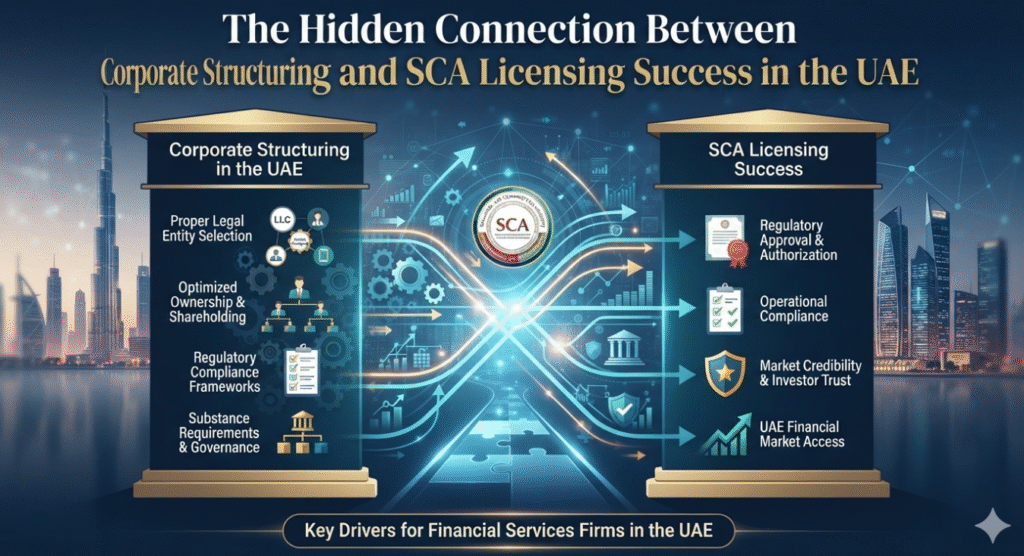
Corporate structuring and SCA licensing success are connected because both ultimately focus on the same fundamental question: can the proposed business operate in a transparent, accountable, and well-controlled manner? A company’s legal entity, ownership arrangements, governance model, management structure, financial framework, and internal responsibilities all contribute to the answer. When these elements are designed independently, inconsistencies can emerge and regulatory readiness may suffer. When they are developed as part of one integrated strategy, the company can present a more credible and operationally coherent profile. Licensing preparation then becomes an extension of the business architecture rather than a separate compliance project added at the end.
For companies seeking to establish or expand regulated operations in the UAE, the most effective starting point is often a detailed assessment of the corporate structure itself. Questions about ownership, control, governance, capital, group relationships, and management authority should be addressed before they become regulatory obstacles. We believe that successful licensing requires businesses to think beyond application forms and focus on the institutional foundations supporting their regulated activities. By combining regulatory knowledge with careful structural planning, we help clients build organizations that are prepared not only for the licensing process but also for the responsibilities that follow authorization. The hidden connection between corporate structuring and licensing success is ultimately straightforward: a regulator can only have confidence in a business when the business itself has clearly defined how it will be owned, governed, managed, funded, and controlled. Building that clarity from the beginning can make the entire regulatory journey more efficient, credible, and sustainable.