

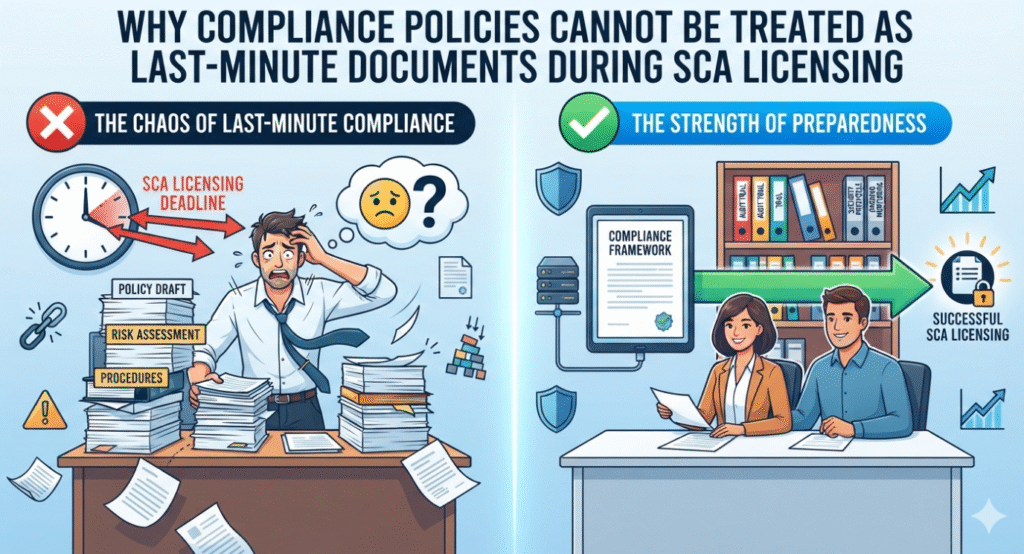
Why Compliance Policies Cannot Be Treated as Last-Minute Documents During SCA Licensing
Securing an SCA license in the UAE requires far more than completing application forms and assembling a collection of corporate documents. A regulated business is expected to demonstrate that it understands its responsibilities and has developed the operational infrastructure necessary to meet them. Compliance policies play a central role in this process because they provide documented evidence of how a firm intends to manage regulatory obligations in practice. Treating these policies as documents that can simply be drafted shortly before submitting an application can create serious weaknesses in the overall licensing strategy. A rushed policy may look complete on paper while failing to reflect the company’s actual structure, activities, governance model, or risk profile. This disconnect can become particularly problematic when regulatory questions require the applicant to explain how its written framework will function in day-to-day operations. The SCA’s regulatory philosophy emphasizes licensing, supervision, and enforcement as interconnected functions, making it essential for firms to approach compliance as an operational foundation rather than an administrative formality.
Compliance Policies Are Part of the Business Architecture
One of the most common mistakes businesses make is separating corporate planning from compliance planning. In reality, these two areas should develop together from the earliest stages of a regulated business. A compliance policy cannot be meaningfully created without understanding the firm’s proposed activities, organizational structure, decision-making processes, client relationships, technology systems, and risk exposure. When policies are prepared at the last minute, they are often based on generic templates that may not accurately represent how the business intends to operate. This can lead to inconsistencies between the application, business plan, organizational chart, operational procedures, and compliance documentation. A stronger approach is to build compliance considerations directly into the business architecture so that every component supports a consistent regulatory narrative.
Regulators Look Beyond the Existence of a Document
Having a compliance policy is not necessarily the same as having an effective compliance framework. Regulatory authorities are concerned with whether policies are practical, relevant, and capable of being implemented within the organization. A document that contains broad statements about compliance but lacks clear responsibilities, procedures, escalation mechanisms, and controls may not demonstrate sufficient operational readiness. Firms should therefore consider how each policy connects to actual people, systems, and business processes. Management should understand its responsibilities, employees should know what procedures apply to their roles, and designated compliance personnel should have the authority and resources needed to perform their functions effectively. SCA regulations and regulatory materials demonstrate the importance placed on governance, internal controls, procedures, and ongoing compliance rather than viewing regulatory obligations as a one-time licensing exercise.
Last-Minute Policies Often Create Internal Contradictions
When documentation is developed under pressure shortly before an application deadline, inconsistencies become much more likely. One document may describe a particular reporting structure while another assigns responsibilities differently. The business plan may refer to services or products that are not adequately addressed within the compliance framework. A policy may assign responsibilities to personnel who have not yet been appointed or describe controls that the company does not actually have the capability to operate. These contradictions can weaken the credibility of the entire application because regulated firms are expected to present a coherent and well-considered operational model. Identifying and resolving such inconsistencies takes time, which is precisely why policy development should begin well before the final stages of licensing preparation.
Generic Templates Cannot Replace Tailored Compliance Frameworks
Templates can be useful starting points, but they should never be treated as a complete substitute for business-specific compliance documentation. Every regulated firm has its own proposed activities, ownership structure, governance arrangements, client profile, operational model, and risk considerations. A policy borrowed from another organization may include procedures that are irrelevant while failing to address risks that are directly applicable to the applicant. This becomes especially concerning when senior management cannot clearly explain the contents of the policies submitted under the firm’s name. Effective compliance documentation should reflect how the organization will genuinely operate rather than simply reproduce regulatory terminology. At Keepers Compliance, we believe that the strongest frameworks are built around the actual business model, allowing compliance procedures to support operations instead of existing separately from them.
Policy Development Requires Input From Multiple Functions
Compliance should not be developed in isolation by treating it solely as a legal writing exercise. Strong policies often require input from senior management, operations teams, finance professionals, technology personnel, risk specialists, and designated compliance officers. Each stakeholder can provide important information about how the business will function and where practical risks may arise. For example, a procedure may appear appropriate from a purely regulatory perspective but be difficult to implement without the right technology or personnel. Early collaboration allows these issues to be identified before they become embedded in formal documentation. It also helps create ownership throughout the organization because relevant personnel understand the procedures they will eventually be expected to follow. When policy development is left until the last minute, there is rarely enough time for this level of meaningful collaboration.
Compliance Policies Must Align With Governance Structures
Governance and compliance are closely connected because policies need clear accountability to function effectively. A company must establish who is responsible for oversight, who performs specific controls, who receives reports, and who has the authority to escalate concerns. These responsibilities should align with the organizational structure presented during the licensing process. If a policy identifies committees, officers, or reporting lines that do not correspond with the company’s actual governance arrangements, questions can arise regarding implementation readiness. Building policies early allows businesses to refine governance structures alongside their regulatory framework. This creates consistency between board responsibilities, executive management duties, compliance functions, risk management, and internal controls. The result is a more credible operational model in which policies reflect genuine accountability rather than theoretical arrangements created solely for an application.
Early Preparation Creates Time for Risk Assessment
A meaningful compliance framework should be informed by an understanding of the risks associated with the proposed regulated activities. Risk assessment takes time because businesses must identify potential vulnerabilities, evaluate their significance, and determine which controls are appropriate. Rushed policy drafting often skips this analytical process and moves directly toward generic language. As a result, the final documents may contain broad commitments without clearly demonstrating how the company intends to identify, manage, monitor, and report specific risks. Early preparation gives management an opportunity to examine potential regulatory, operational, financial, technological, and reputational exposures before formalizing procedures. It also allows controls to be tested against realistic business scenarios rather than remaining purely theoretical. This risk-based approach produces documentation that is more useful both during licensing and after the business begins operating.
Policies Need to Be Operationalized Before Licensing
A compliance policy becomes significantly more valuable when the organization has considered how it will actually be put into practice. This involves determining whether the firm has appropriate personnel, reporting mechanisms, record-keeping processes, technology tools, and management oversight. A last-minute document may promise regular monitoring or periodic reviews without establishing who will perform them or how the results will be documented. Similarly, a policy may require employee training without considering the content, frequency, and evidence needed to demonstrate that training has occurred. Operationalization helps transform policies from written commitments into functioning controls. This distinction is critical because regulatory compliance continues long after a license has been granted. Companies that begin implementation planning early are generally better positioned to transition from licensing preparation into ongoing regulatory operations.
Rushed Documentation Can Delay the Licensing Process
Many businesses assume that delaying compliance documentation saves time during the early stages of company formation. In practice, postponing this work can create significant pressure and additional delays later. When policies are finally prepared, they may reveal gaps in the proposed organizational structure or require changes to operational procedures that have already been designed. The company may then need to revise multiple documents to restore consistency across the application. Additional questions or clarification requests can further extend the process when the regulatory framework appears incomplete or insufficiently aligned. Early policy development allows potential issues to be identified when they are easier and less costly to address. A structured approach therefore supports greater efficiency by reducing the likelihood of major revisions immediately before submission.
Compliance Is an Ongoing Commitment, Not an Application Requirement
One of the most important reasons to avoid last-minute policy preparation is that licensing is only the beginning of the regulatory journey. Once authorized, a regulated firm must continue to maintain appropriate controls and adapt to applicable regulatory expectations. Policies may need periodic review as the business evolves, new products are introduced, responsibilities change, or regulatory requirements are updated. A framework that was created hastily for the purpose of obtaining approval may become difficult to maintain because no genuine implementation structure exists behind it. Businesses should instead view the licensing phase as an opportunity to establish the foundations of their long-term compliance culture. This mindset encourages management to invest in sustainable processes rather than focusing exclusively on the immediate objective of submitting an application. Regulatory materials also emphasize ongoing compliance and internal control arrangements, reinforcing that regulatory readiness extends beyond the initial authorization stage.
Strong Policies Improve Management Decision-Making
Well-developed compliance policies do more than satisfy regulatory expectations because they can also improve the quality of internal decision-making. Clear procedures help management understand when approvals are required, when risks should be escalated, and how sensitive situations should be handled. Employees benefit from having defined guidance instead of relying entirely on individual judgment when compliance questions arise. Consistent policies can also reduce uncertainty as the business grows and new team members join the organization. When compliance requirements are integrated into operational processes, management can make strategic decisions with a clearer understanding of regulatory consequences. This creates a more disciplined business environment where compliance becomes part of organizational governance rather than a reactive function. Developing these policies early gives leadership the opportunity to use them as management tools rather than treating them as static documents stored for regulatory purposes.
Building Credibility Through Regulatory Readiness
A well-prepared licensing application should communicate that the company has carefully considered what it means to operate in a regulated environment. Compliance policies contribute to this impression when they are coherent, tailored, and supported by an appropriate operational structure. Conversely, documentation that appears rushed or disconnected from the proposed business can undermine confidence in the firm’s overall preparedness. Regulatory readiness is demonstrated through consistency between what a company says it will do and how it has structured itself to do it. This requires time, collaboration, and careful analysis across multiple areas of the business. The strongest approach is therefore to begin compliance planning alongside corporate structuring and operational development. Keepers Compliance supports firms through this process by helping transform regulatory requirements into practical frameworks that are aligned with both licensing objectives and long-term operational needs.
The Strategic Value of Starting Early
Treating compliance policies as an early-stage priority can fundamentally improve the quality of an SCA licensing strategy. It provides sufficient time to understand applicable obligations, identify business-specific risks, establish clear governance responsibilities, and align operational procedures with regulatory expectations. Early preparation also allows firms to identify weaknesses before they become urgent obstacles near the application deadline. Instead of assembling documents reactively, businesses can develop an integrated framework in which corporate structure, business activities, internal controls, and compliance procedures support one another. This creates a stronger foundation not only for the licensing process but also for the period following authorization. For companies entering the UAE’s regulated financial environment, compliance documentation should therefore be treated as part of building the business itself. With the right planning and specialist guidance, Keepers Compliance helps organizations approach SCA licensing with a framework designed for genuine readiness, sustainable compliance, and long-term regulatory confidence.