

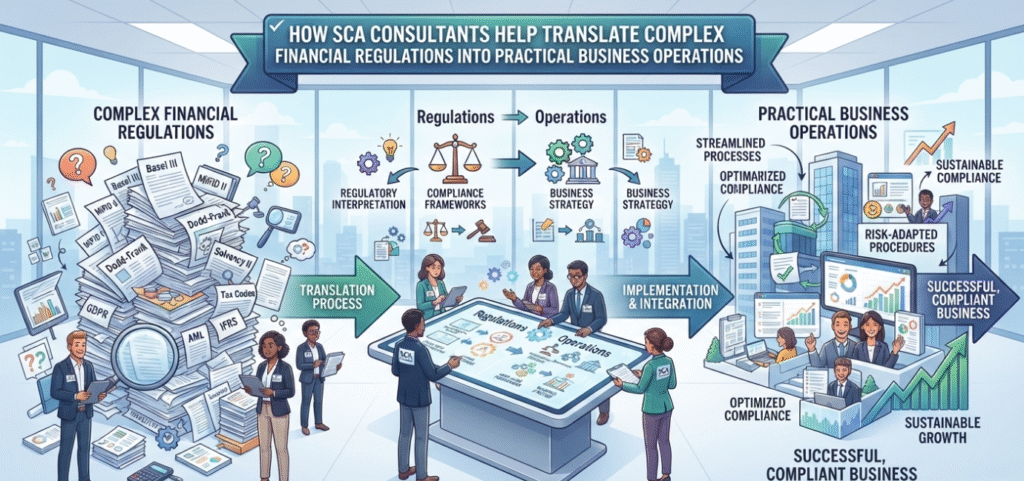
Understanding the Gap Between Regulations and Daily Business Activities
Financial regulations are designed to create transparency, protect investors, strengthen market integrity, and reduce operational risks. However, for businesses entering the UAE financial services sector, understanding regulatory requirements on paper is only the first part of the challenge. The more difficult task is determining how those requirements should influence the company’s structure, internal processes, employee responsibilities, technology, client interactions, and decision-making procedures. SCA-regulated businesses are expected to demonstrate more than awareness of the rules, as their operational framework must reflect the standards established by the regulator. This creates a significant gap between legal and regulatory language and the practical realities of running a business. SCA consultants play an essential role in bridging this gap by interpreting complex requirements and converting them into workable systems that employees and management teams can implement consistently. The objective is not simply to help a company understand what the regulations say, but to establish operational practices that make compliance a functioning part of the business.
The Securities and Commodities Authority framework involves multiple areas of responsibility, including governance, risk management, financial controls, compliance oversight, anti-money laundering measures, documentation, reporting, and professional suitability. These requirements cannot operate independently because weaknesses in one area can create compliance concerns across the organization. For example, a well-written compliance policy has limited value if employees do not understand how to apply it during client onboarding or daily transactions. Similarly, an internal control framework may appear comprehensive on paper but fail when responsibilities are unclear or reporting processes are inconsistent. This is why experienced consultants focus on operational translation rather than merely providing regulatory summaries. They examine how a business actually intends to function and identify the processes required to align commercial activity with regulatory expectations. By connecting regulatory obligations with practical workflows, consultants help create a structure that is both compliant and operationally realistic.
Turning Regulatory Language Into Clear Internal Procedures
Regulatory documents are often detailed, technical, and written to establish broad standards that apply across different financial activities. Business owners and operational teams, however, need practical instructions that answer specific questions about who is responsible for each task, when an action must be taken, what information must be documented, and how issues should be escalated. This is one of the most valuable functions of an SCA consultant. Rather than leaving regulatory requirements open to interpretation, consultants help transform them into internal procedures tailored to the company’s licensed activities and business model. These procedures may cover areas such as client onboarding, KYC reviews, transaction monitoring, record keeping, risk assessments, internal approvals, complaints handling, and regulatory reporting. The goal is to ensure that compliance requirements become understandable actions rather than abstract obligations stored within policy documents. When employees have clear procedures to follow, businesses can reduce inconsistency and strengthen their ability to demonstrate regulatory discipline.
Effective translation also requires recognizing that no two financial services businesses operate in exactly the same way. A brokerage firm, investment advisory business, asset manager, or other regulated entity may face different operational risks and regulatory expectations. Using generic policies without considering the actual structure of the business can create gaps between written documentation and real-world activities. SCA consultants analyze the company’s services, governance model, staffing arrangements, client relationships, and operational processes before developing compliance frameworks. This approach helps ensure that procedures reflect how the organization genuinely operates rather than presenting an artificial version of the business for regulatory purposes. Practical compliance requires alignment between the business plan, internal manuals, financial projections, management responsibilities, and daily workflows. When these elements support each other, the organization is better positioned to maintain consistency during regulatory reviews and inspections. At Keepers Compliance, we focus on helping businesses build this connection between regulatory expectations and practical execution.
Aligning Business Structures With Regulatory Requirements
One of the earliest areas where regulatory interpretation becomes critical is company structuring. A financial services business may begin with a strong commercial idea but discover that its proposed structure does not fully support the regulatory obligations associated with its intended activities. Licensing requirements can involve considerations related to ownership, governance, senior management suitability, capital resources, internal controls, and qualified personnel. Decisions made at the beginning of the business can therefore influence compliance responsibilities long after the license has been obtained. SCA consultants help businesses evaluate these considerations before regulatory issues become embedded within the operating model. This includes reviewing whether the proposed business activities align with the appropriate regulatory category and whether the organizational structure supports effective oversight. A well-planned structure allows compliance responsibilities to be integrated into the company from the beginning rather than added later as corrective measures.
The relationship between organizational design and compliance is particularly important because regulators assess whether a company has genuine operational readiness. A business cannot rely solely on external documentation while maintaining unclear internal responsibilities. Management teams need to understand who oversees risk, who manages compliance obligations, who maintains records, and how important issues are escalated. Consultants help define these responsibilities in a way that supports accountability across the organization. They can also identify situations where existing roles need clearer separation to reduce conflicts of interest or improve independent oversight. This creates a stronger governance environment and makes internal decision-making more structured. Instead of viewing organizational requirements as administrative burdens, businesses can use them to establish clearer management systems. The result is an operating model that supports both regulatory compliance and more disciplined business management.
Developing Compliance Frameworks That Work in Practice
A major challenge for regulated companies is avoiding the creation of policies that look impressive but are rarely used by employees. Compliance manuals must be more than documents prepared for licensing applications or inspections. They should provide meaningful guidance that supports daily decisions across different departments and functions. SCA consultants help businesses develop frameworks that connect regulatory requirements with actual operational scenarios. This means considering how employees onboard clients, review documentation, identify potential risks, report concerns, and maintain appropriate records. The consultant’s role is to ensure that policies are sufficiently detailed to meet regulatory expectations while remaining practical enough for staff members to follow. A strong framework creates consistency by establishing repeatable processes rather than relying on individual interpretation.
Practical implementation also involves testing whether procedures can function under normal business conditions. A policy may require escalation of certain issues, but the business must know exactly who receives the escalation and what happens next. A risk management process may identify operational concerns, but management needs a method for monitoring those concerns and documenting corrective actions. Similarly, AML requirements must be connected to client onboarding, transaction review, employee awareness, and reporting responsibilities. Consultants help businesses connect these individual components into a broader compliance ecosystem. This integrated approach reduces the risk of isolated policies that do not communicate with each other. It also helps management understand how information should move throughout the organization when a compliance issue arises. By focusing on implementation, we help transform regulatory frameworks into systems that can support the business throughout its operations.
Making Risk Management Relevant to Commercial Decisions
Risk management can sometimes be treated as a separate compliance exercise with limited connection to commercial decision-making. In a regulated financial business, however, risk considerations should influence many aspects of daily operations. Business expansion, new products, client relationships, outsourcing arrangements, technology adoption, and internal process changes can all introduce new regulatory or operational risks. SCA consultants help companies establish methods for identifying and evaluating these risks before they become significant problems. Rather than simply maintaining a risk register, businesses need to understand how identified risks affect specific departments and activities. Consultants can assist management in developing practical assessment processes that connect risk identification with corrective actions and ongoing monitoring. This allows risk management to become part of strategic planning instead of an exercise completed solely for compliance purposes.
A practical risk framework also helps employees recognize when an issue requires additional attention. Frontline staff may encounter unusual client behavior, incomplete documentation, conflicts of interest, operational errors, or other concerns that require escalation. Without clear guidance, these issues can be overlooked or handled inconsistently. Consultants help create escalation structures that define when concerns should be reported and how management should respond. Regular reviews can then be used to determine whether existing controls remain effective as the business evolves. This is particularly important for growing companies because operational complexity often increases faster than internal control systems. A framework that worked effectively during the initial licensing stage may require adjustments as client volumes, staffing levels, and service offerings expand. By maintaining a practical approach to risk management, businesses can adapt their compliance controls without disrupting commercial operations.
Supporting Employees Through Clear Compliance Responsibilities
Regulatory compliance cannot be managed effectively by one department alone. While compliance officers and senior management have specific responsibilities, employees throughout the organization may contribute to the company’s overall regulatory position. Client-facing teams may collect important information during onboarding, operations teams may maintain records, finance teams may support reporting obligations, and management may be responsible for governance and strategic oversight. SCA consultants help businesses identify how these responsibilities should be distributed across the organization. This reduces the risk of employees assuming that compliance is someone else’s responsibility. Clear allocation of duties also makes it easier to identify accountability when a process is incomplete or a control has failed. Employees can perform more effectively when they understand how their actions contribute to the company’s regulatory obligations.
Training is another important part of translating regulations into practical operations. Employees do not necessarily need to become regulatory experts, but they should understand the requirements that directly affect their responsibilities. Generic training can be useful for awareness, but role-specific guidance is often more effective for practical implementation. Consultants can help organizations develop training approaches based on the actual risks and activities associated with different positions. This may involve explaining how to recognize unusual activity, how to maintain appropriate documentation, or when to escalate a potential concern. Ongoing education also helps businesses adapt when internal procedures or regulatory expectations change. A knowledgeable workforce provides an important layer of protection because compliance issues can often be identified earlier when employees understand what to look for. This creates a more proactive operational culture where regulatory awareness supports better decision-making.
Connecting Licensing Requirements With Long-Term Operations
Many businesses concentrate heavily on the licensing application stage and assume that regulatory pressure decreases once approval has been obtained. In reality, licensing is the beginning of an ongoing compliance relationship. The operational systems presented during the licensing process must continue to function after the business begins serving clients and conducting regulated activities. This is why consultants provide value beyond application preparation. They help organizations transition from a licensing project into a sustainable compliance environment. Policies must be maintained, internal controls must be monitored, records must be preserved, and regulatory obligations must continue to receive appropriate attention. A company that treats its licensing documentation as a one-time exercise may eventually experience a gap between its documented procedures and actual business practices. Long-term operational support helps prevent this disconnect.
Ongoing compliance also requires businesses to recognize when internal changes may have regulatory implications. Expanding into new services, hiring senior personnel, changing ownership structures, adopting new technologies, or modifying client processes can affect the company’s compliance framework. Consultants help management evaluate these developments through a regulatory lens before changes are implemented. This allows businesses to plan growth while maintaining appropriate oversight. Instead of discovering compliance issues after operational decisions have been made, management can include regulatory considerations within the decision-making process from the beginning. This approach is more efficient because it reduces the need for extensive corrective work later. It also supports a culture where commercial growth and regulatory responsibility are treated as connected priorities rather than competing interests. Keepers Compliance supports this long-term perspective by helping businesses establish compliance structures that remain practical as operations develop.
Improving Regulatory Communication and Inspection Readiness
Communication with regulators requires accuracy, consistency, and a clear understanding of the underlying business operations. When a regulator requests information, the response should align with the company’s policies, records, organizational structure, and actual activities. Inconsistencies can raise questions about the effectiveness of internal controls or the accuracy of previous submissions. SCA consultants help businesses prepare for these situations by ensuring that important compliance information is organized and accessible. They can also help management understand how to respond to regulatory queries in a structured and professional manner. Effective preparation reduces the pressure associated with inspections and reviews because the company has already established processes for maintaining evidence of compliance. Instead of gathering information reactively, the organization can demonstrate that its compliance systems operate continuously.
Inspection readiness is not simply about preparing documents shortly before a regulatory visit. It involves maintaining records, reviewing internal controls, addressing identified weaknesses, and ensuring that employees understand relevant procedures. Consultants can conduct readiness assessments that identify gaps before they become significant concerns. These assessments may examine whether policies reflect current operations, whether required documentation is complete, and whether staff members understand their responsibilities. Corrective actions can then be prioritized based on the level of regulatory and operational risk involved. This creates a more systematic approach to regulatory preparation. Businesses that maintain continuous readiness are generally better positioned to manage unexpected reviews or requests for information. More importantly, the processes developed for inspection readiness often improve the company’s overall operational discipline.
Creating a Compliance Culture That Supports Growth
The most effective approach to regulatory compliance is one where compliance becomes part of the business culture rather than a separate administrative function. This does not mean allowing regulations to slow every commercial decision or creating unnecessary layers of approval. Instead, it means designing processes that allow the business to identify regulatory considerations efficiently and address them appropriately. SCA consultants help organizations develop this balance by focusing on proportional and relevant controls. A growing business needs systems that protect the organization without making ordinary operations unnecessarily complicated. The right framework should provide clarity while allowing employees and management to perform their responsibilities efficiently. When compliance is integrated into operations, businesses can make informed decisions with greater confidence.
A strong compliance culture also contributes to credibility with clients, investors, banking partners, and other stakeholders. Financial services companies operate in an environment where trust is closely connected to governance and operational discipline. Demonstrating a commitment to structured compliance can therefore support broader business objectives beyond simply meeting minimum regulatory obligations. Consultants help businesses recognize these strategic benefits and develop systems that strengthen long-term resilience. This may involve improving internal accountability, enhancing documentation standards, strengthening risk awareness, or establishing more consistent management oversight. Over time, these improvements can support more sustainable growth and reduce the likelihood of disruptive compliance failures. The ultimate objective is to create an organization where regulatory expectations are understood as part of responsible business operations. When this foundation is established properly, compliance can support growth rather than becoming an obstacle to it.
The Value of Expert Translation in a Complex Regulatory Environment
Complex financial regulations require more than a basic understanding of legal terminology. Businesses must be able to interpret regulatory expectations and convert them into governance structures, policies, workflows, employee responsibilities, monitoring systems, and management practices. This translation process requires both regulatory knowledge and an understanding of how financial services organizations operate in practice. SCA consultants provide this essential bridge by helping businesses move from theoretical compliance to operational implementation. Their work can begin during the licensing process but often continues as the company develops and faces new challenges. By identifying gaps early and creating practical systems, consultants help organizations reduce uncertainty and build stronger compliance foundations. The result is a more structured business that is better prepared to meet its regulatory responsibilities.
For financial services companies in the UAE, effective compliance should never exist only within policy manuals or regulatory submissions. It must be visible in the way the organization makes decisions, manages risks, serves clients, maintains records, and responds to operational challenges. We believe that the strongest compliance frameworks are those that employees can understand and management can actively oversee. Regulatory complexity becomes more manageable when requirements are broken down into clear responsibilities and repeatable processes. With the right expertise, businesses can move beyond viewing SCA obligations as a collection of difficult rules and begin treating them as a framework for stronger governance and operational resilience. Keepers Compliance helps organizations make this transition by connecting licensing expertise with practical, ongoing compliance support. Through this approach, we help businesses build operations that are prepared not only for regulatory approval but also for sustainable participation in a highly regulated financial environment.